
Dr Rozina Iqbal shares her story of a life-changing diagnosis for her baby which resulted in a heartbreaking loss not long after his birth.
On 29 April 2025, expectant mother, Rozina from Pakistan, attended her routine 20-week scan with her husband, Muhammad Shahid. Then began a path of uncertainty and complex decisions, following their baby, Muhammad Tayyib, being diagnosed with a fetal cardiac abnormality.
At the 20-week scan, fetal medicine specialist, Dr Nuruddin Mohammed began to scan the baby’s organs and let Rozina and Shahid know the sex of the baby – a boy. But then he came across a conotruncal problem with the aorta.
“My tears of joy had turned into tears of despair. In that single appointment, we came to understand how vital, early and accurate prenatal diagnosis can be, not only in identifying congenital heart disease, but in preparing families for the journey ahead.
“I remember the cold gel still on my belly, the ultrasound probe paused mid-scan, and the way the room suddenly felt soundproof except for my own heartbeat pounding in my ears”, said Rozina.
Nuruddin carefully guided the expectant parents through the probable diagnosis and the situation at hand. He said it was most likely dextro-position transposition of great arteries (d-TGA), and a second opinion from a perinatal cardiologist would help to reach a conclusion. Eventually the d-TGA diagnosis was confirmed, and a suspicion of coarctation of the aorta added further complexity to the anticipated postnatal course. The pediatric cardiologist counseled them, regarding the baby’s anatomy, possible complications and treatments.
Despite the poor prognosis of d-TGA in Pakistan, it’s a treatable condition globally, so Rozina and Shahid wanted nothing other than to continue with the pregnancy. They began exploring the options for corrective cardiac surgery to see if this would give Tayyib a better chance of survival. They started planning with as much hope and determination as they could muster, pursuing surgical options abroad.
Once Rozina and Shahid found a suitable hospital to treat Tayyib’s condition, they were faced with further complications. The sizes of the aortic and pulmonary arteries were significantly disproportionate, with possible coarctation of the aorta, increasing the risk of complications and the need for arch repair with arterial switch.
As a pediatrician, Rozina was familiar with many congenital heart disease cases with poor outcomes. Knowing the medical risks was one thing but facing them herself as a mother was another thing entirely.
She said: “I couldn't help but prepare myself for the worst. This latest development broke us.”
On 8 September 2025, Tayyib was born via Cesarean section at term, with a weight of 3.16kg. The neonatal intensive care unit (NICU) team was present in the operating room for immediate resuscitation.
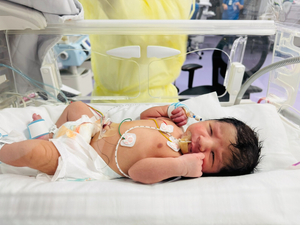
“When we heard his first cry, the emotions we felt cannot be put into words. His fight began immediately, as he was quickly wired to monitor his vitals. Not being able to hold him made me anxious beyond measure”, Rozina shared.
Tayyib’s oxygen saturation began declining rapidly, as expected. After three long days, spent in the NICU, he underwent major open-heart surgery. The surgery was deemed successful, though the next 48 hours were critical and he developed a series of complications a week later.
On 28 October 28 2025, after 50 arduous days in critical care, Tayyib became hypotensive and bradycardic despite maximal support. Rozina and Shahid made the decision not to pursue CPR, in favour of prioritising their baby's comfort. In those moments, with maximum intervention in place, the doctors told Rozina they felt it was going to be Tayyib's last moments and asked if she had a final wish. Their little one took his final breaths after Rozina held him close and fed him for what would be the last time.
“After everything he went through, I find comfort in believing that he is now in a better place, free from all the suffering he endured”, said Rozina.
“My message to parents walking a similar path to mine is this: as human beings, we have limitations. Understand that medicine and technology, despite all their advancements, do not offer guarantees. Every baby is different. Every heart defect is different. Every child responds differently to surgery, medications, and recovery. What works beautifully for one may not work the same way for another.”
Almost one year on, Rozina shared her story with ISUOG, in line with the Every Little Heart Matters campaign. At this time, we spoke to one of her doctors, Nuruddin, who said:
“The value of prenatal diagnosis extends beyond influencing the outcome. Sometimes its greatest value is in giving families time to understand the diagnosis, seek appropriate counselling, consider their options and plan the safest possible pathway for their baby. When a major congenital heart defect is detected before birth, our responsibility is not only to make the diagnosis as accurately and as early as possible, but also to support families through the decisions that follow, with compassion and respect for their values.”
Find out more about the Every Little Heart Matters campaign.