
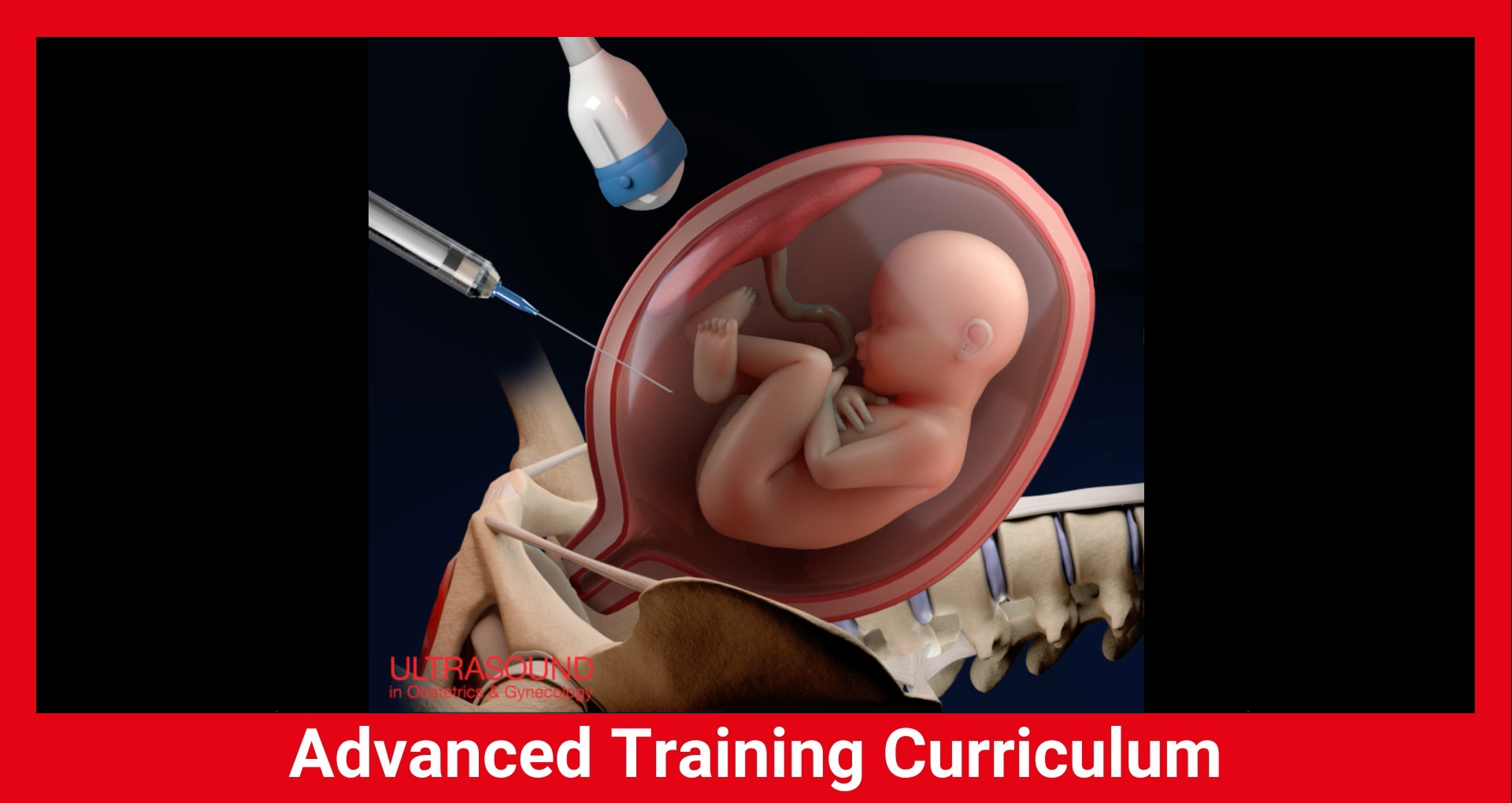
This Advanced Training Course is based on the ISUOG Guidelines on Invasive Procedures and is intended to give an overview and theoretical foundation of invasive procedures in obstetrics, providing advanced instruction in both diagnostic and therapeutic interventions.
Overview
Course name: ATC5 Invasive Procedures: Obstetrics
Duration of course: 7 hours (+ supplementary materials)
Length of access for each course: 12 months
Certificates: 7 CME credits and ISUOG Certificate of Completion
Access: Online learning, learn at your own pace.
Education level: Advanced
Program language: English
Suitable for: Practicing obstetricians, trainees, fellows, residents, radiographers, sonographers, GPs and healthcare professionals providing antenatal care and performing ultrasound scans.
Why do this course?
This course is essential for clinicians aiming to develop competence in the rapidly advancing field of invasive fetal procedures. It provides a structured, evidence-based foundation aligned with ISUOG Guidelines, covering both diagnostic and therapeutic interventions used to diagnose, monitor, and treat fetal conditions before birth. By offering advanced theoretical training, the course helps practitioners build the knowledge required for safe, effective, and up-to-date clinical practice in maternal–fetal medicine, supporting improved outcomes and patient care.
Course description
Invasive fetal procedures represent one of the most rapidly advancing areas within maternal–fetal medicine, offering the potential to diagnose, monitor, and treat fetal conditions before birth. As techniques evolve and outcomes improve, clinicians require structured training to ensure procedural competence, patient safety, and evidence-based practice. This Advanced Training Course, Invasive Procedures: Obstetrics is based on the ISUOG Guidelines on Invasive Procedures and is intended to give an overview and theoretical foundation of invasive procedures in obstetrics, providing advanced instruction in both diagnostic and therapeutic interventions.
Contributors to this course
Course contributors: Andrew Cowling, Lina Youssef
Course materials: Professor Anthony Odibo, Dr. Magda Sanz-Cortes, Professor Laurent Salomon, Professor Eduard Gratacos, Professor Jan Deprest, Professor Ahmet Baschat, Professor Rogelio Cruz-Martinez, Professor Jan Rychik, Professor Julien Stirnemann, Professor Carol Benson, Professor Anthony Johnson, Professor Hiba Mustafa, Professor Dick Oepkes, Dr. Michael Bebbington, Dr. Nimrah Abbasi, Dr. C. Ekelund, Dr. I Scharnreitner, Dr. A. Lawin O'Brien, Dr. F. Fontanella
Learning objectives
- Understand the indications, contraindications, and ethical considerations of invasive fetal procedures; apply principles of asepsis, imaging guidance, and complication management.
- Describe the techniques, timing, and diagnostic value of amniocentesis and chorionic villus sampling.
- Recognize indications and understand how to perform ultrasound-guided fetal sampling; interpret diagnostic findings and manage procedure-related complications.
- Understand the indications, technical approaches, and monitoring requirements for intrauterine transfusion; manage complications and evaluate fetal outcomes.
- Identify candidates for shunt placement; describe procedural technique, troubleshooting, and follow-up strategies.
- Explain the rationale, technique, and timing of fetoscopic tracheal occlusion; assess procedural outcomes and limitations.
- Recognize indications for in-utero cardiac procedures; describe principles of fetal valvuloplasty and septoplasty; interpret echocardiographic guidance and outcomes.
- Compare fetoscopic and open approaches to the prenatal repair of spina bifida; understand perioperative management and long-term neurodevelopmental implications.
- Outline pathophysiology, prenatal imaging features, and emerging fetal treatment strategies for prenatal intervention in vein of Galen malformations.
- Define indications and techniques for selective fetal reduction; discuss procedural safety, follow-up, and ethical considerations.
- Explain how the pathophysiology of TTTS and TAPS relates to principles and technique of selective fetoscopic laser photocoagulation.
Key questions
- What clinical and sonographic factors guide the selection of patients for invasive diagnostic testing such as amniocentesis or chorionic villus sampling?
- How should procedure-related risks, including pregnancy loss and infection, be quantified and communicated during pre-procedural counselling for invasive fetal procedures?
- In the context of fetal anemia, what are the indications for transfusion and what parameters determine timing of repeat transfusion?
- What are the optimal technical approaches and safety measures for ultrasound-guided fetal blood sampling to minimize fetal bradycardia and cord injury?
- When is vesicoamniotic or thoracoamniotic shunt placement indicated, and what ultrasound findings predict procedural success or failure?
- What clinical criteria and imaging findings determine eligibility for fetoscopic tracheal occlusion in congenital diaphragmatic hernia?
- Which sonographic features identify candidates for in-utero cardiac interventions, and how do procedural outcomes influence postnatal management?
- How do the fetoscopic and open approaches to prenatal spina bifida repair differ in terms of maternal morbidity, gestational timing, and long-term neurological outcomes?
- What are the indications and ethical considerations surrounding selective fetal reduction, and how do procedural techniques influence survival of the co-twins?
- What potential does fetoscopic laser photocoagulation have to improve perinatal outcomes in complications of monochorionicity?
Prices
Prices for ISUOG members
| ISUOG member | £75 |
| ISUOG member - with trainee/sonographer discount * | £40 |
| ISUOG member in middle-income setting | £40 |
| ISUOG member in lower-resource setting | £10 |
* Please note that this discount is NOT applicable to ISUOG members situated in a middle-income or lower-resource setting. We may need to verify your status, which may take some time to review.
Prices for ISUOG non-members*
| Non-member | £85 |
| Non-member in middle-income setting | £50 |
| Non-member in lower-resource setting | £15 |
* Prices for non-members does NOT include ISUOG membership. Join as an ISUOG member first for discounted prices to our online training courses (allow 24 hours for systems to update).
Trainees/residents and sonographers/radiographers
Proof of status: All trainees, residents, sonographers and radiographers will need to submit proof of their trainee, resident, sonographer or radiographer status by way of a letter from their Department or Institution. The letter must be in English and dated within the last 3 months and submitted by email to [email protected] along with the name of the course you wish to purchase.
Sonographer definition: A sonographer is a non-physician medical imaging professional who performs diagnostic medical sonography, or diagnostic ultrasound.
Trainee/resident definition: A trainee is a medical professional who is not yet fully qualified or practicing without supervision within their chosen specialty and in accordance with the relevant national regulatory authorities; a resident is in residency training which leads to specially or subspecialty) certification.
Low resource country discount
ISUOG's mission is to disseminate the highest quality education to the broadest audience. To support this aim, we have ensured that attendees based in, currently residing in, or currently working in low resource countries have the lowest purchase costs. ISUOG's low resource country list can be viewed here https://www.research4life.org/access/eligibility/.
No other discounts can be used in conjunction with this rate. These rates will appear automatically in the ISUOG Academy based on your membership details, or registered details. Please make sure these details are up to date.
Middle income country discount
ISUOG's mission is to disseminate the highest quality education to the broadest audience. To support this aim, we have ensured that attendees based in, currently residing in, or currently working in middle income countries have access to reduced purchase costs. ISUOG has identified the following countries whose economies fall within the middle income category as defined by the World Bank.
The full classification list can be found below
| Argentina | ||||||||
| Belarus | ||||||||
| Brazil | ||||||||
| China | ||||||||
| Costa Rica | ||||||||
| Dominican Republic | ||||||||
| India | ||||||||
| Indonesia | ||||||||
| Iran | ||||||||
Kazakhstan
|
No other discounts can be used in conjunction with this rate. These rates will appear automatically in the ISUOG Academy based on your membership details, or registered details. Please make sure these details are up to date.
Further information
Accreditation and CME Credits
CME credits
The European Accreditation Council (EACCME) accredits this online course for Continuing Medical Education (CME). European CME credits (ECMEC®) will be awarded on successful completion of this course. Through an agreement between the European Union of Medical Specialists (UEMS) and the American Medical Association (AMA), physicians may convert EACCME credits to an equivalent number of AMA PRA Category 1 CreditsTM. Information on the process to convert EACCME credit to AMA credit can be found at www.ama-assn.org/go/internationalcme.
CME Subcommittee
The CME Subcommittee oversees the CME requirements for our CME accredited courses.
Conflict of Interest
No commercial support has been accepted related to the development or publication of this course. This course underwent peer review in line with the standards of editorial integrity and publication ethics maintained by the International Society of Ultrasound in Obstetrics & Gynecology (ISUOG). Conflicts of interest have been identified and resolved in accordance with EACCME guidelines.
You can find out how we adhere to the essential criteria for EACCME accreditation requirements here.
Technical requirements
You can study on your phone, tablet or laptop. To participate and access this activity you will need a good internet connection and an up to date browser:
- MS Internet Explorer 11 (Not including compatibility modes)
- MS Edge
- Mozilla Firefox version 60 Extended Support Release (ESR)
- Google Chrome 73
- Safari 10 auf OS X
- Mobile Browser Android >4 and iOS > 9
- Current versions of Adobe Reader plugin
Terms and Conditions
You can find our full Terms and Conditions, and Privacy Policy here.
You can find our Refund Policy here.
You must be an ISUOG member to get a discounted price and additional resources; or simply subscribe to our newsletter to access the Basic Training Online Program at the non-member price.
Please note: You will get a receipt from the online shop after purchase which can be used for your accounts and expenses, we do not offer additional invoices for ecommerce products.
Obstetrics - key assessments course list
Other courses in this series that are available:
- ATC5 Preterm birth and cervical assessment
- ATC5 Abnormal growth patterns
- ATC5 Pre-eclampsia
- ATC5 Third trimester ultrasound scan and management
- ATC5 Third trimester fetal anomalies
- ATC5 Intrapartum ultrasound